For stores and marketplaces · Arabic and English
The checkout is where the design is tested.
Recast designs e-commerce stores and marketplaces on subscription: product page, cart, checkout and every failure state, for $3,900 a month with five tasks worked at once and first concepts in 48 hours. Arabic storefronts are designed right-to-left natively, and checkouts for Gulf shoppers are drawn with the payment methods they expect, such as mada in Saudi Arabia. Front-end build in React, Next.js, Webflow or Framer is included.
Checked · by Daniel Makhamreh, lead designer at Recast
- Price
- $3,900 a month, billed monthly. No annual contract, no tiers.
- Scope
- Product page, listing, cart, checkout, order tracking and account.
- Checkout
- Every failure state drawn: declined card, sold-out item, rejected address.
- Arabic
- Storefronts in Arabic and English, right-to-left designed natively.
- Build
- Front-end build hours included: React, Next.js, Webflow, Framer.
- Speed
- First concepts in 48 hours, seven days a week.
- Try it
- $490 one-week pilot, up to three tasks, credited against month one.
The work
What does an e-commerce design team work on first?
The three screens every order passes through: the product page, the cart and the checkout. A store can have a plain home page and still sell; it cannot have a confusing checkout.
After those, the work moves outward to the screens that bring people in and the ones that follow the order.
Product page
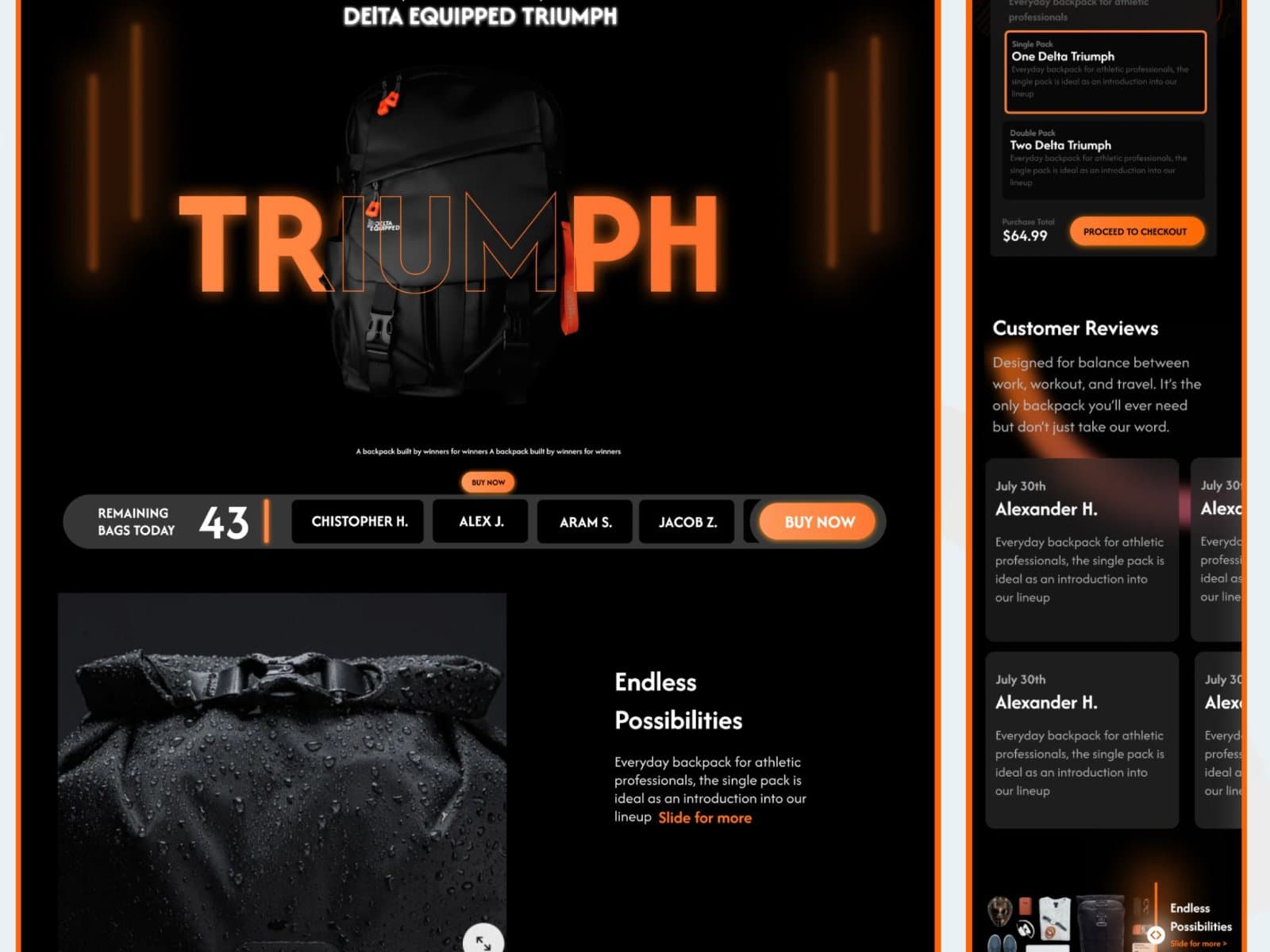
What the thing is, what it costs, whether it is in stock and when it arrives. The Delta Equipped store shows remaining stock live.
Listing and filters
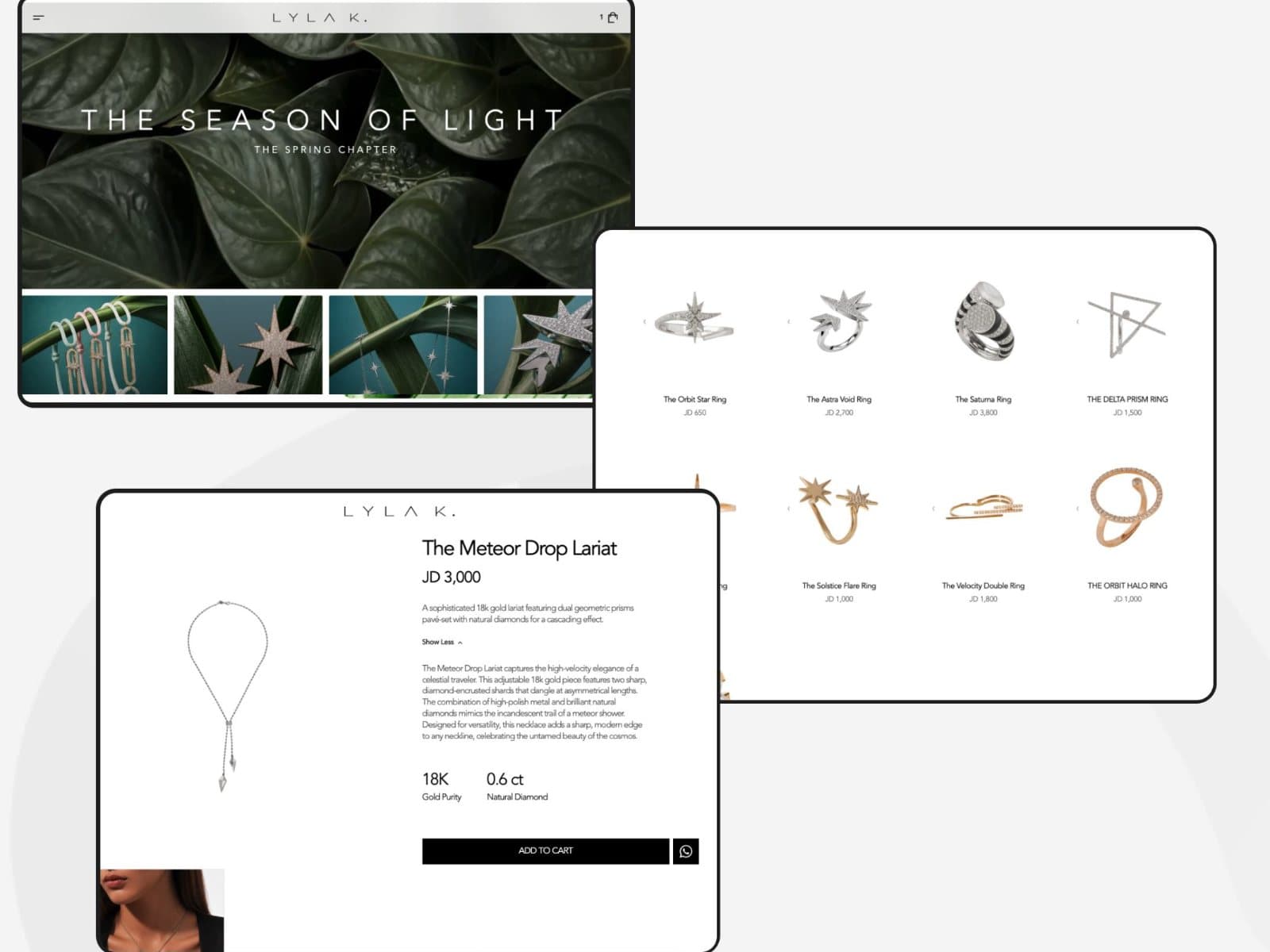
A grid that gives each product room, and filters that match how people choose. Lyla K. is arranged by bracelets, earrings, necklaces and rings.
Cart
Editable, honest about delivery cost, and reachable from every page.
Checkout
As few fields as the order needs, no forced account, and every failure state.
After the order
Confirmation, tracking, returns, and the emails that carry them.
The checkout
Where do checkouts lose orders, and what can design change?
At the points where cost, effort or trust surprise the shopper. Baymard Institute's average across 50 studies is that 70.22 per cent of carts are abandoned. In its survey of US shoppers, 40 per cent cite extra costs, 18 per cent being made to create an account, and 17 per cent a checkout that was too long or complicated.
Baymard's benchmark puts the average US checkout at 23.48 form elements and says 12 to 14 can be enough. The rest is what happens when something fails, and those states need drawing too.
| What is compared | What the shopper often sees | What the design does |
|---|---|---|
| Card declined | A generic error and an emptied form | Keeps every field, says what to try, offers another method |
| Bank verification fails | A blank page after the 3-D Secure step | A return screen that says the order is not placed and the cart is kept |
| Item sells out | An error at the last step | Names the item, keeps the rest, offers an alternative |
| Address not accepted | A red field with no reason | Says what is missing, in the shopper's language |
| No delivery to the area | Discovered after the payment details | Checked when the address is entered |
Card declined
- What the shopper often sees
- A generic error and an emptied form
- What the design does
- Keeps every field, says what to try, offers another method
Bank verification fails
- What the shopper often sees
- A blank page after the 3-D Secure step
- What the design does
- A return screen that says the order is not placed and the cart is kept
Item sells out
- What the shopper often sees
- An error at the last step
- What the design does
- Names the item, keeps the rest, offers an alternative
Address not accepted
- What the shopper often sees
- A red field with no reason
- What the design does
- Says what is missing, in the shopper's language
No delivery to the area
- What the shopper often sees
- Discovered after the payment details
- What the design does
- Checked when the address is entered
Arabic
What does an Arabic storefront need beyond translation?
It needs to be designed right-to-left as its own version: layout, type, prices and search, not the English store mirrored with the strings replaced.
Direction
The grid, the gallery, the breadcrumb and the checkout steps run right to left. Card numbers, emails and phone numbers stay left to right inside it.
Prices
One rule for digits and for where the currency sits. The UAE Central Bank's guideline puts the dirham symbol to the left of the numerals and never beside the code AED, and the riyal has had its own symbol since 2025.
Mixed names
Brand and product names in Latin script sit inside Arabic sentences. Each is isolated so the order holds.
Search and filters
People search for the same product in Arabic and in English. Filters, sizes and delivery options are written in Arabic by someone who reads it.
Type
An Arabic typeface chosen to pair with the Latin one, with more line height and no letter-spacing.
Payments
Which payment methods does a Gulf checkout need?
Cards and Apple Pay in all three markets, then the local methods each one expects. Recast designs where they appear and how they fail; your payment provider supplies them.
Addresses differ as well. Saudi Arabia has a National Address short code of four letters and four numbers, and Jordan has no countrywide addressing system, so the form there asks for a map pin and a landmark.
| What is compared | Saudi Arabia | UAE | Jordan |
|---|---|---|---|
| Local payment | mada, the national scheme owned by the Saudi Central Bank | Aani, instant payment by phone number or QR code | CliQ, instant transfer to an alias or by QR code |
| Also expected | Instalments: Tabby and Tamara are licensed by the Saudi Central Bank | Cash on delivery, which a US government trade guide still describes as prevalent | Mobile wallets, through the JoMoPay switch |
| Apple Pay | Available; mada cards can be added | Available | Available |
| Currency | Riyal, two decimals, official symbol since 2025 | Dirham, two decimals, symbol to the left of the numerals | Dinar, three decimals |
Local payment
- Saudi Arabia
- mada, the national scheme owned by the Saudi Central Bank
- UAE
- Aani, instant payment by phone number or QR code
- Jordan
- CliQ, instant transfer to an alias or by QR code
Also expected
- Saudi Arabia
- Instalments: Tabby and Tamara are licensed by the Saudi Central Bank
- UAE
- Cash on delivery, which a US government trade guide still describes as prevalent
- Jordan
- Mobile wallets, through the JoMoPay switch
Apple Pay
- Saudi Arabia
- Available; mada cards can be added
- UAE
- Available
- Jordan
- Available
Currency
- Saudi Arabia
- Riyal, two decimals, official symbol since 2025
- UAE
- Dirham, two decimals, symbol to the left of the numerals
- Jordan
- Dinar, three decimals
The build
Can you build the store as well as design it?
The front end, yes. Front-end build hours are included in the plan, in React, Next.js, Webflow or Framer, by the same team that designed the screens.
Both e-commerce case studies were designed and built this way. Lyla K. is an editorial store with an integrated payment gateway and an order system that records each purchase as it happens. Delta Equipped is a product-led store with live inventory, customer reviews and dynamic filtering.
If your store runs on a platform outside that list, the design is delivered as Figma with components, tokens and spec frames for your developers. Either way the files are yours on delivery.
A store built this way keeps design and build in one queue: a change to the product page is a task, not a new project.
Questions
Asked before the call.
Do you design for Shopify, WooCommerce or a custom store?
- We design the store in Figma for any platform. The included build hours cover React, Next.js, Webflow and Framer, so on Shopify or WooCommerce the theme is built by your developer from the file, with components, tokens and spec frames.
Can you redesign only the checkout?
- Yes. Cart, checkout and its failure states are three tasks, which is the size of the $490 pilot: one week, delivered by the week's end.
Do you design marketplaces with a seller side?
- Yes. SWERV, in our case studies, is a marketplace where brands find creators, with a dashboard for both sides, discovery with filters and a campaign workflow from brief to approval. A marketplace is filed as two sets of flows, one for each side.
Should prices in an Arabic store use Arabic-Indic or Western digits?
- Either, chosen once per market and used everywhere. Unicode's locale data defaults to Arabic-Indic digits for Saudi Arabia and Jordan and to Western digits for the UAE, and Apple notes that usage varies within countries. The digits of a card number, phone number or order code never change order.
Can cash on delivery and instalments be designed into the checkout?
- Yes. Each is a payment option with its own states: the fee and the confirmation for cash on delivery, the split and the hand-off to the provider for instalments. Your payment provider supplies the methods; we design how they appear.
How long does a store redesign take on the plan?
- There is no fixed project length. A store is a queue of tasks: product page, listing, cart, checkout, account. Five are worked at once, first concepts on each arrive in 48 hours and revisions are unlimited. When the queue is empty you can pause.
Sources
- Baymard Institute: cart abandonment rate statistics, read
- Saudi Central Bank: mada, read
- Saudi Central Bank: the Saudi riyal symbol, read
- Saudi Press Agency: SAMA licenses Tabby for buy-now-pay-later, read
- Saudi Press Agency: SAMA licenses Tamara Finance for consumer finance and buy-now-pay-later, read
- Saudi Post (SPL): National Address and the short address, read
- Central Bank of the UAE: Al Etihad Payments launches Aani (16 October 2023), read
- Central Bank of the UAE: Dirham Currency Symbol Guideline, version 1.0, read
- US Commercial Service, United Arab Emirates country guide: eCommerce, read
- JoPACC: CliQ services, read
- JoPACC: about the Jordan Payments and Clearing Company, read
- US Commercial Service, Jordan country guide: eCommerce, read
- Apple: countries and regions that support Apple Pay, read
- Unicode CLDR: Arabic locale data and currency decimals, read
- Apple Human Interface Guidelines: Right to left, read
Other companies change their prices and terms. If something here is out of date, write to hello@recastux.com and we correct it.
Twenty minutes. Your product on the screen.
The pilot call is with the lead designer who would run your work. Show the screens that bother you most, pick up to 3 tasks for a one-week pilot, and leave knowing the price and the scope. The call is free; the pilot is $490 once, credited against your first month.